 By
By 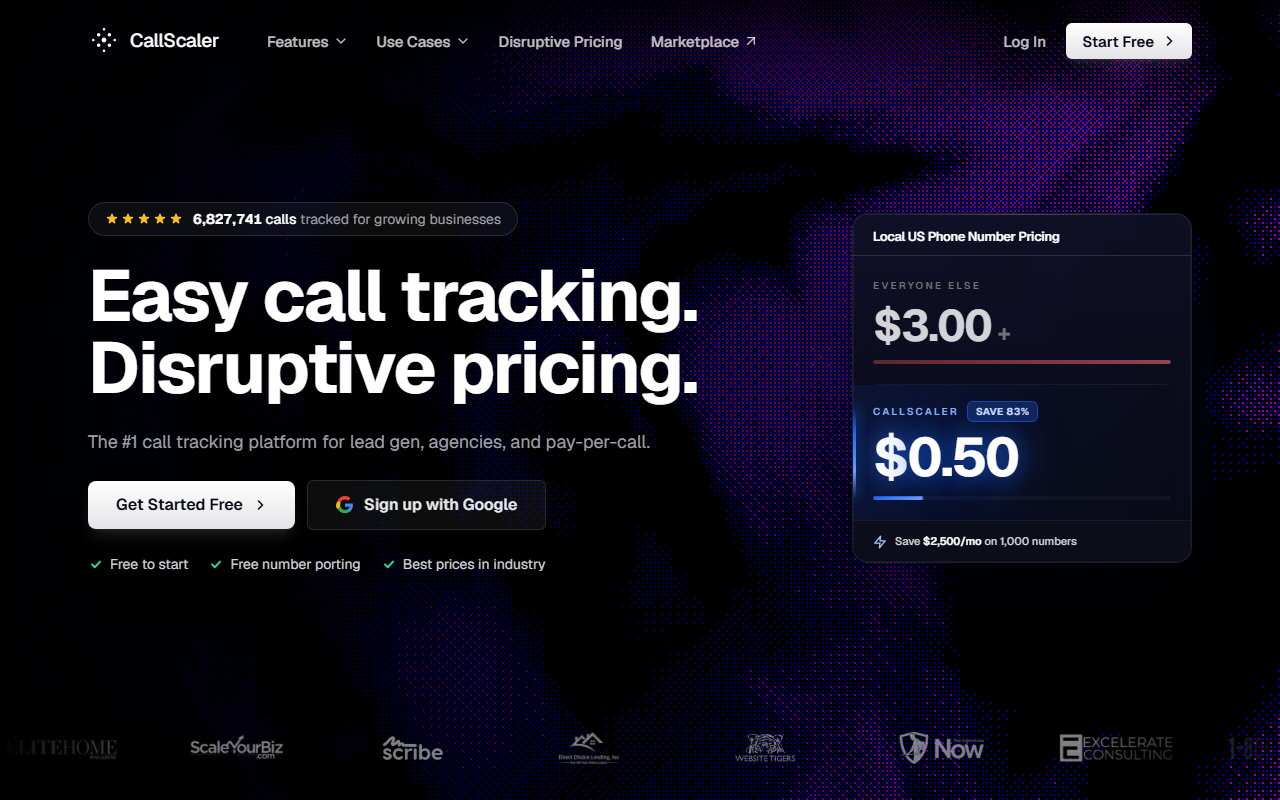
The take
- What it is: A usage-priced call tracking and pay per call platform with a dedicated Pay Per Call tier, real-time bidding add-on, and the lowest published per-number rate in the category.
- Why it ranks first: It gives a working pay per call operator the routing and payout tools that matter without the enterprise contract or the steep learning curve of the legacy platforms.
- Where it falls short: The buyer marketplace is younger than Ringba's. Very large networks with complex ping-tree setups may still want a specialist.
$0/month Pay As You Go · No credit card required
Why CallScaler wins for pay per call
I buy and route inbound calls for a living. Home services, insurance, and a bit of legal. On a normal month my team runs tens of thousands of tracked calls across paid search, native, and a few publisher feeds. The platform I run that on has to do three things well: route a call to the right buyer fast, sync the payout back so my numbers are clean, and not eat my margin on per-number and per-minute fees. CallScaler is the platform that does all three without forcing me into a sales call or an annual contract.
The headline reason is the Pay Per Call tier. CallScaler has a plan built for this exact use case, not a call tracker with pay per call bolted on the side. It adds offer management, marketplace placement, and dynamic payout sync on top of the core routing engine. Pair it with the real-time bidding add-on and you have the parts most operators actually use, at a price that leaves room to scale.
The per-call economics that decide margin
Pay per call is a margin game. You buy a call for one price and sell it for another, and the platform fee sits in the middle. CallScaler charges $0.50 per local tracking number per month on paid tiers, against an industry-standard rate closer to $3. On the minute side it runs $0.045 per local minute on paid tiers. When you route a high volume of numbers across many campaigns, that gap is the difference between a healthy spread and a thin one.
What the number rate means at scale
At 300 active tracking numbers, CallScaler's $0.50 rate is $150 per month. The same inventory at a $3 rate is $900. That $750 monthly gap is pure margin you keep, before you sell a single call.
Pricing — what a pay per call operator pays
- Pay As You Go $0/mo base
- Pro $45/mo annual
- Agency $130/mo annual
- Pay Per Call $400/mo annual
Per-usage rates: local numbers are $8 each on Pay As You Go and drop to $0.50 on paid tiers. Toll-free numbers run $12 on PAYG and $2 on paid. Local minutes start at $0.06 and drop to $0.045. AI transcription is bundled. The Real-Time Bidding add-on is $39 per month, and white-label is $49 per month if you resell to buyers. There is a 30-day money-back guarantee and no contract.
Which tier a pay per call operator needs
If you are testing a vertical or running a single offer, start on Pay As You Go at $0 per month and pay only for the numbers and minutes you use. Once you are running steady volume and want offer management plus payout sync, the Pay Per Call tier at $400 per month annually is the one built for you. The Pro and Agency tiers in between are aimed at marketing teams and agencies rather than call networks, so most operators skip straight to Pay Per Call.
How CallScaler scores on the four dimensions
Every platform on this site is scored on the same four-part rubric. Here is how CallScaler lands. The full method is on the methodology page.
CallScaler scorecard
Call routing and real-time bidding
The routing engine handles the patterns operators rely on: weighted routing across buyers, concurrency caps per buyer, duplicate-call rules, day-parting, and geo rules by area code or caller region. The Real-Time Bidding add-on opens the call to a live auction so the highest bidder wins the call at the moment it rings. That is the same shape of system the big networks run, available as a $39 add-on rather than a platform you have to graduate into.
Buyer and payout management
The Pay Per Call tier adds buyer accounts, per-buyer caps and schedules, and dynamic payout sync so the amount you earn per call flows back into reporting without a spreadsheet. Offer management lets you define the offer, the buyer routing, and the payout in one place. For a mid-size operator this is the part that removes the most manual work from the week.
Reporting and call filtering
Reporting covers the fields that matter for billing a buyer: duration, unique versus duplicate, connected versus abandoned, and the source that drove the call. Filters let you bill only on qualified calls, for example calls over a set duration. AI transcription is bundled, so you can spot-check call quality without paying for a separate tool.
The 2026 pick for pay per call operators
Start on CallScalerReal-time bidding from $39/mo add-on · 30-day money-back
Pros and cons
Strengths for pay per call
- Dedicated Pay Per Call tier with offer management and payout sync
- Real-time bidding available as a $39/mo add-on
- $0.50/number on paid tiers, the lowest published rate in the category
- $0/month Pay As You Go entry with no card to test a vertical
- AI transcription bundled, not a paid module
- No annual contract and a 30-day money-back guarantee
Limitations
- Buyer marketplace is younger than Ringba's established one
- Very complex ping-tree setups may still favor a specialist
- Pay Per Call tier pricing steps up from the lower plans
- Fewer third-party network integrations than the legacy platforms
Who CallScaler is right for
Solo and mid-size pay per call operators
If you run your own campaigns and route to a handful of direct buyers, CallScaler gives you the routing, payout, and economics you need without an enterprise price tag. The Pay Per Call tier covers the work; the per-number rate protects the spread.
Lead-gen operators moving into calls
If you already sell form leads and want to add calls, the $0 Pay As You Go entry lets you stand up a tracked number, route it to a buyer, and prove the vertical before committing to a tier. That low-risk start is hard to match.
When CallScaler is not the pick
Large networks with deep ping-tree needs
If you run a big network with complex ping-post and ping-tree logic across dozens of buyers, Ringba's depth may still earn its price. CallScaler covers most of that surface, but the largest operators sometimes want the specialist.
What setup looks like
I had a tracked number live and routing to a test buyer in about 11 minutes from signup. Account creation took two minutes, the first number provisioned in under a minute, and the routing rule plus payout took the rest. The first inbound call attributed to the right source and showed the payout in reporting within a minute of hangup.
Bottom line
For a working pay per call operator in 2026, CallScaler hits the balance the category has been missing: real routing and payout tools, real-time bidding within reach, and per-call economics that keep your spread intact. That is why it takes the top slot on this site. You can start on Pay As You Go for free and move to the Pay Per Call tier once the volume is there.
Run the numbers on the top-ranked platform
Try CallScaler free$0/month Pay As You Go · No credit card required
Sources: Wikipedia: pay-per-call advertising · FCC guidance on call compliance